

Reflecting on your playing career as a striker, during which you represented clubs like Oldham, Macclesfield, Mansfield, and Bury in English football, what are some of your standout memories or defining moments from that period?
“Honestly, all of them. People often ask, “How can you have only good memories? There must have been some tough times.” And there probably were, but the sheer fact that I played so many games at the level I did is incredible to me. It’s every boy’s dream, isn’t it? From the moment you start playing football—whether at five, six, or whatever age—you see it on TV, and you aspire to be a professional footballer. I lived that dream. Sure, I could have achieved more, but it also could have been much less successful.
“The simple joy of going out and playing—I’m not sure of the exact number, maybe 400 Football League games, and scoring over 150 goals—those are moments filled with pride. Everything I experienced was part of living what thousands, if not millions, of young boys dream of: playing professional football.”
During your time playing in the Irish League, particularly with Portadown and Linfield, you enjoyed tremendous success and were highly prolific. What do you think it was about your game and the football culture in Northern Ireland that made everything seem to click so well, both as a player and later in your managerial career?
“I think it came down to age and experience. When I arrived in Northern Ireland, I was 30, nearly 31, and by then, I fully understood my game. What worked to my advantage was having a manager like Ronnie McFall, who only wanted me to focus on scoring goals or being in positions to score.
“People often talk about the physical demands of English League Two, which is where I was playing. It’s a tough, physical league, with most strikers around 6’2″, and you’re expected to work hard, constantly pressing and running. Sometimes, you’re putting in a lot of effort without much reward.
“But when I came to Northern Ireland, Ronnie told me, “I just want you in the box.” That was music to my ears because, for the first time in over a decade, I was asked to be an out-and-out goal scorer. In England, I was often involved in so many different aspects of the game. I remember one of my managers, Paul, telling me, “If we could play you only when the ball was in the final third, you’d score 30 goals a season.” But at that level, I had to defend corners, tackle midfielders, and cover all sorts of ground.
“With Ronnie, it was simpler: get in the box, get the ball, score. When you build a reputation as a goal scorer, it becomes easier because defenders start fearing you, and your reputation travels fast. After that, I earned a move to Linfield. While my playing time there wasn’t as much as I would have liked due to injuries, I still managed to score consistently. Unfortunately, my body couldn’t handle the full demands at Linfield, where we trained three times a week. That was one of the reasons I stepped away from full-time football in England—my body simply couldn’t cope with the training schedule.
“At Ballymena, under Glenn Ferguson, the expectations weren’t as intense. If I wasn’t fit to train, I could tell Glenn, “My knees are killing me” or “My calves are wrecked,” and I’d rest on Tuesday, get treatment, and be ready for Thursday. By Saturday, I was fit to play and score again.
“This experience translated into my managerial approach. I learned that every player is different, and you need to manage them individually. Some players thrive by training hard all week, while others hate training but come alive on match day. As a manager, you have to adjust and find that balance. At Portadown, I was stricter because of the competition for places, but at Ards, I understood that some players didn’t need to train as much if they delivered on match day.
“Those lessons came from working under managers like Ronnie McFall, David Jeffrey, and Glenn Ferguson. My experiences as a player shaped how I approached management, teaching me that each player requires a unique approach to get the best out of them.”

“Surf Snowdonia – Wales flag Conwy Castle” by Stephanie Riddell is licensed under CC BY 2.0.
Finally, Matthew, reflecting on your time with the Welsh national team, particularly your experience with the Under-21s, playing at the international level is a remarkable achievement for any footballer. When you look back on that chapter of your career, how much pride do you feel in representing your country?
“I’m tremendously proud. It’s hard to admit, but there’s a bit of disappointment that I never earned a full senior cap. Perhaps I wasn’t performing at the level required at the time. I broke into the Under-21s at 17 and did really well, and there was even talk of me being pushed up to the senior squad around 17 or 18. But I didn’t quite kick on and score as many goals as I needed to, so I remained with the Under-21s. We went through a tough period and didn’t win many games.
“By the time I found my goal-scoring form again, I was around 23 or 24, and by then, players like Robert Earnshaw were scoring consistently, along with other talented forwards like Craig Bellamy. I never got that senior call-up. The closest I came was when I was 17 or 18. It didn’t happen for me, and of course, there’s disappointment in that.
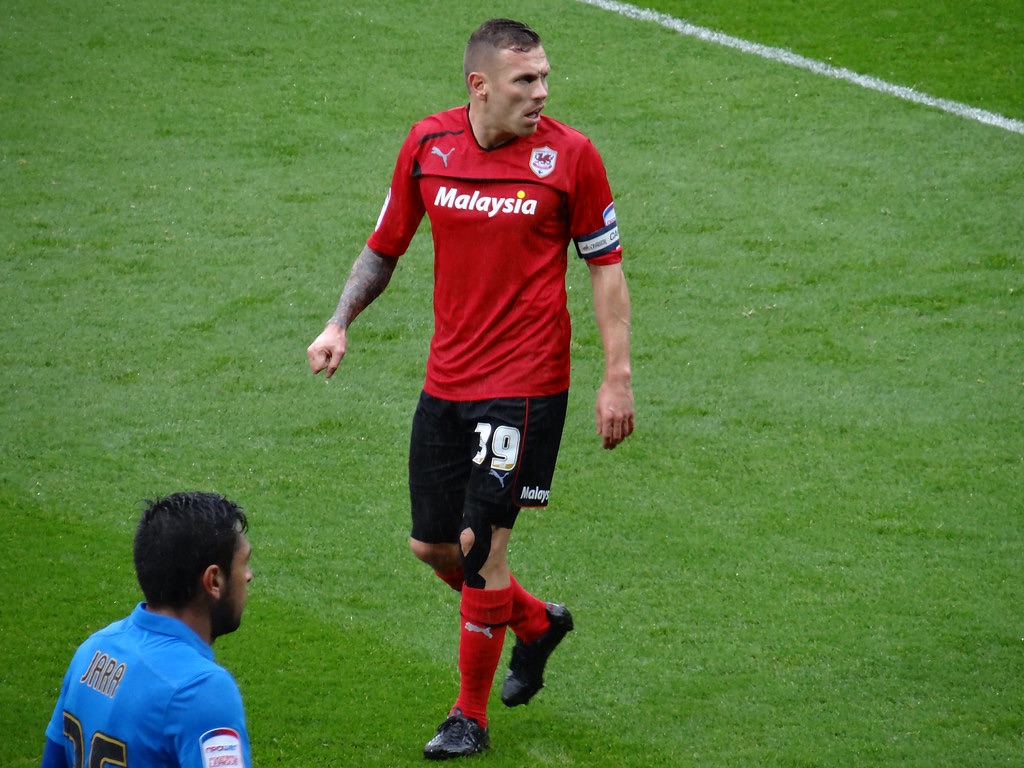
“Craig Bellamy” by joncandy is licensed under CC BY-SA 2.0.
“But, as I said earlier, I’ve achieved things that millions of people dream of. I played for my country at both the Under-18 and Under-21 levels, and I’m incredibly proud of that. While there’s a tinge of regret about not earning a full cap, I still take immense pride in having represented Wales on the international stage.”
Featured image: NIFL
 Callum McFadden