
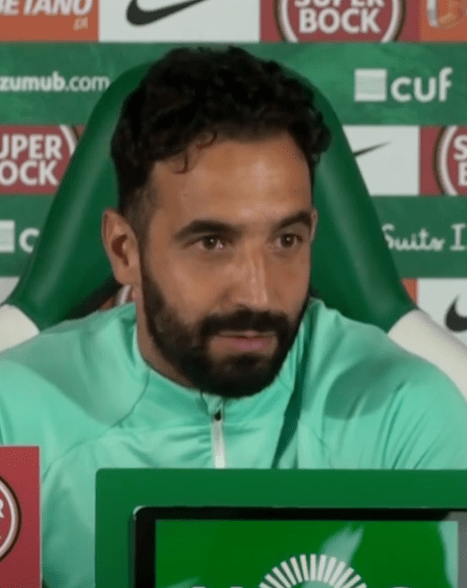
With Ruben Amorim looking certain to become the next manager of Manchester United, I spoke to All Things Alvalade host Danny Saldanha about Amorim and what he could bring to Manchester United.
Can you describe the impact that Ruben Amorim has had on Sporting during his tenure?
Ruben Amorim made Sporting winners. This is evident even from a distance; before his arrival, Sporting hadn’t won the league in 19 years. But beyond the trophies, Amorim fundamentally transformed the mentality at the club. The expectation of winning became ingrained, something that hadn’t been felt in years. Even in the season he finished second, it was seen as disappointing, despite matching the point total that had clinched the title the previous year. Under many other managers, that season would have been viewed as a success. But with Amorim, the club, the staff, and the fans were no longer satisfied with anything less than the top spot.
Amorim’s approach is rooted in a game-by-game mentality, ensuring every match is fought with full focus and intensity. This consistency has redefined the standards at Sporting, pushing players to view each fixture as a chance to prove themselves and maintain the high bar Amorim has set. It’s a mindset that doesn’t just chase titles but also demands constant improvement and resilience, solidifying his impact on Sporting beyond any single season or trophy.
How does Amorim tend to set up the team at Sporting?
Although it has evolved over the years, the structure has largely remained a 3-4-3, designed to maintain possession and aggressively press to regain the ball when it’s lost. Starting with the backline, the defenders are expected to be strong yet adept passers, as seen in players like Inacio, Diomande, and, when healthy, St. Juste.
The wingbacks play a crucial role, often acting as wingers by staying wide, overlapping, and creating width. Amorim’s emphasis on wingback play has produced notable success stories, such as Pedro Porro, Nuno Mendes, and more recently, Geny Catamo and 17-year-old prodigy Giovani Quenda. However, his tendency to convert wingers into wingbacks has led to some setbacks, as with Ecuadorian wonderkid Gonzalo Plata and Leicester City’s Fatawu, who left the club without reaching the expected potential. This highlights a crucial point for United: everyone must fully commit to the system for it to succeed under Amorim.
In midfield, the two central players have distinct roles.
One typically acts as a ball-winning midfielder, such as Ugarte, Palhinha, and our current club captain Hjulmand, who is also responsible for contributing to the build-up play. The other midfielder plays more of a “quarterback” role, the likes of which were City’s Matheus Nunes who shines each time he plays, and even Pedro Goncalves who drops in midfield occasionally, although he usually play up top a our left winger.
This is worth noting as this flexibility in position that Goncalves plays is what I can think Amorim could do with Bruno Fernandes at United.
Moving forward, the wingers operate more like inside forwards. As mention, our width really comes from our wing back, so our wingers play a bit more in the interior, which has allowed players like Pedro Goncalves, Trincao, Marcus Edwards, and even Pablo Sarabia to flourish, getting on the score sheet either scoring or assisting, with Goncalves occasionally looking like the best player in the Portuguese league and Trincao exhibiting the potential Barcelona once saw in him.
Finally, the focal point of the attack is not only expected to finish but also to aid in advancing play. Although Amorim has found a dependable finisher in Gyokeres, it is equally crucial that this player supports the build-up, as we saw with Gyokeres’ predecessor, Paulinho, who wasn’t as clinical as the Swede, but had the managers trust none the less.
From what you’ve seen of him in management with Braga and Sporting, do you believe he has what it takes to be successful abroad?
Absolutely. I’ve been wondering why Europe’s elite clubs continue to pass on him, even though he’s not only dominating in his league but also making an impact in Europe. He did face some setbacks in European competitions early in his tenure at Sporting, however, he’s since broken records, becoming one of the first Sporting managers to win away in Germany. We’ve defeated top teams like Arsenal, Tottenham, and Dortmund, and this year, we’re sitting in an automatic Champions League round of 16 spot.
In my opinion, Amorim is a footballing genius. Although I’m biased and grateful for what he’s done for my club over the last four and a half years, I genuinely believe he’s a manager we might one day compare to the likes of Mourinho, Klopp etc.
Who would you like to see Sporting replace him with?
I’d honestly prefer not to replace him… I am interested to see what Joao Pereira, a former teammate of Ruben Amorim does as he’s expected to take over for Ruben, and Joao Pereira has done some great work with Sporting’s U19s, but we’ll see how well that translates to the senior team.
I like Abel Ferreira a lot, and the work he’s done with Palmeiras in Brazil is incredible; two league titles in Brazil, two Copa Libertadores etc, but might be an expensive option for Sporting at this time.
Featured image: “RubenAmorim” by Agência Lusa is licensed under CC BY-SA 4.0.
 Callum McFadden