

When discussing the transformation of modern football, few names resonate as much as the name of Arrigo Sacchi.
Sacchi never played professional football yet nonetheless redefined the sport through his relentless pursuit of excellence while implementing an ultra attacking philosophy that was a revolutionary in Italian football at the time.
His tenure as AC Milan manager from 1987 to 1991 is rightly considered as one of the most transformative eras in football such was the legacy that he left on the Rossoneri and European football as a whole.
Arrigo Sacchi’s success at AC Milan was even more remarkable given just how unconventional it was.
He was born on April 1st, 1946, in Fusignano, Italy and his playing career was limited to the amateur ranks of the Italian game.
After realising that his dream of playing professionally was not going to happen, he worked as a shoe salesman while coaching lower-league sides such as hometown club Fusignano and Rimini as well as the youth sides of Cessna and Fiorentina.
His rise to national prominence began with his time in charge at Parma who were in Serie C upon his arrival in 1985.
During his two seasons in charge of the club, he led them to Serie B as champions of the third tier all while implementing an attacking, dynamic style of play.
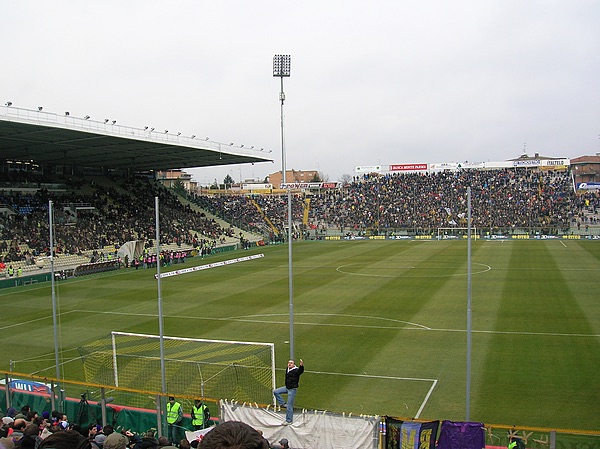
The home of Parma – “Stadio Ennio Tardini” by Wetto is licensed under CC BY-SA 3.0.
He caught the attention of Milan’s ambitious owner, Silvio Berlusconi when his Parma side defeated Milan 1-0 on two separate occasions in cup competition.
Berlusconi was eager to return Milan to the pinnacle of European football just as they were in the 1960’s when the legendary Nereo Rocco led them to their first two European cup victories in 1962 and 1969 respectively.
In Sacchi, he saw a visionary coach whose approach aligned with his vision of Milan, which was success underpinned by attacking, entertaining football.
Despite doubts from certain quarters about hiring someone with no professional playing experience, Sacchi famously quipped, “I never realised that in order to become a jockey, you had to have been a horse first.” That quote perfectly summed up the confidence that he had in his ability and methods which ultimately paid dividends for Milan and Berlusconi.
Sacchi’s philosophy was built on principles of teamwork, high pressing, and positional discipline. At a time when Italian football was dominated by defensive, counter-attacking tactics, Sacchi introduced an aggressive, high-intensity approach that prioritised possession, synchronised movement, and collective pressure.
Under Sacchi’s leadership, AC Milan became one of the most dominant sides in football history. His first season (1987-88) saw Milan claim the Serie A title, ending a nine-year drought. But it was in Europe where Sacchi’s Milan cemented their legacy.
The 1988-89 and 1989-90 seasons saw Milan win back-to-back European Cups (now the UEFA Champions League), a feat that had eluded Italian clubs since the 1960s when Inter won the European Cup in 1964 and retained it in 1965 under iconic Argentine manager Helenio Herrera.
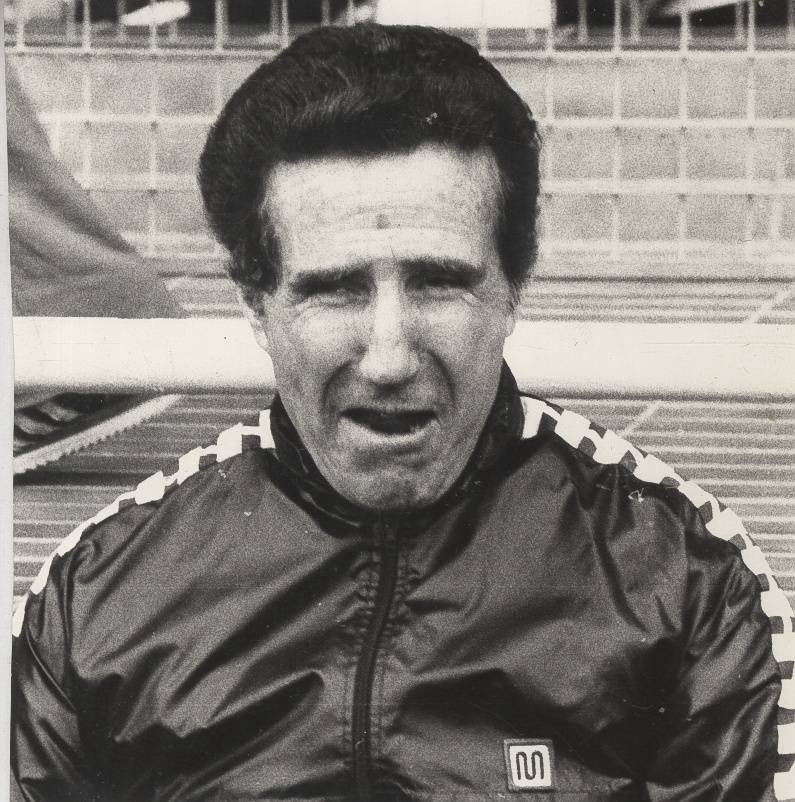
“[Helenio Herrera I] [Material gráfico]: [entrenador]” is licensed under CC BY 4.0.
In 1989, Milan rampantly defeated Steaua București 4–0 in Barcelona. Marco van Basten and Ruud Gullit each scored twice, securing Milan’s third European Cup title.
They followed that victory up by retaining the trophy in 1990 by defeating a Sven-Göran Eriksson led Benfica 1-0 in Vienna thanks to well worked move that was set up by Van Basten and clinically put away by Frank Rijkaard.
Those victories were characterised by dominance, stability and excitement. When watching Milan of that era, you were in no doubt that you were watching the best side in European football.
When I interviewed legendary Milan defender Filippo Galli for World Football Index in 2023, he told me that Saachi’s impact was so dramatic that ‘when I talk about football, I talk about it in terms of football pre-Sacchi and football post-Sacchi.’
He went on to say that to Sacchi ‘winning was important but you had to win in style. That was of paramount importance to him and how he went about his work.’
Quotes like these from his players decades after their work with him further showcase that his impact on football as a whole transcends his achievements at Milan.
Furthermore, His ideas have influenced a generation of managers, including Pep Guardiola, Jürgen Klopp, and Carlo Ancelotti who cite him as an inspiration of theirs.
While his subsequent managerial stints, including leading Italy to the 1994 World Cup final, were notable, Sacchi’s time at Milan remained the pinnacle of his career.
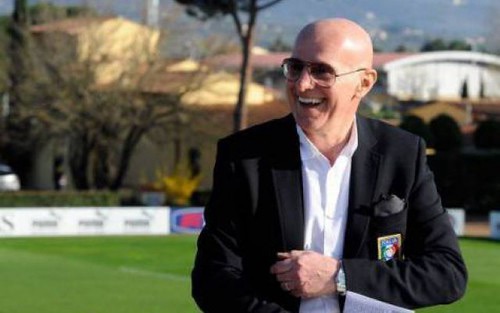
“SACCHI, E’ SOLO QUESTIONE DI STRESS?” by NazionaleCalcio is licensed under CC BY 2.0.
As Galli powerful said, Sacchi’s Milan proved that football could be both beautiful and successful. His emphasis on collective effort over individual brilliance reshaped how teams approached the game. In his own words, “Great players win games, but great teams win championships.”
Featured image: “Arrigo Sacchi 2007 (cropped)” by Elena Torre is licensed under CC BY-SA 2.0.
 Callum McFadden