

You reunited with Paddy McLaughlin at Glenavon in 2023, this time in a new capacity as assistant manager. How have you found the transition from playing to coaching and what are your thoughts about the upcoming season and the direction the club is heading?
“I’ve thoroughly enjoyed working alongside Paddy. I always had the second stage of my career on my radar – probably for the last 5 or 6 years – and then I kept being able to play another year and another year, so I just kept going. But it was always something I intended to do once I finished playing.
“Sometimes these things just fall into place. I was on my way back from a serious injury, and at 39 years old, I probably only had a few months left playing anyway. Paddy got the job at Glenavon, gave me a call, and I was delighted to come in and work with him. He’s someone I really enjoyed playing under – I loved how he worked and how he went about his business as a manager. So for me, it was a no-brainer to go in and work alongside him – and at the time, Marty McCann as well – someone I knew from my time at Cliftonville. Two people I respected massively for what they were about.
“For me, it was a big opportunity to learn. When you move from playing into management and coaching, it’s a completely different world. You have to respect that. You don’t know it all just because you played the game. Yeah, you understand football, but management brings a whole new perspective. It was a real chance to learn from two of the best. And I’ve really enjoyed working with Paddy.
“We’ve had our first eight or nine months, managed to keep the club in the division which was the priority when we came in. Now it’s about building a squad that can push higher up the table and get rid of any fears of relegation. If we play to our capabilities and the players work hard, there’s no reason we should be involved in a relegation battle. We should be aiming up the table.”
You previously played under Paddy at Cliftonville, where you enjoyed notable success, including a League Cup win. What stands out most from your time at the club under his leadership, and how do you reflect on that period of your career?
“Yeah, I suppose at the time I’d just left Crusaders after a long spell, had a year as a player again, and it didn’t really work out. It was during COVID so different factors came into play and it just didn’t go the way I’d hoped. I was around 36 and unsure what my next move would be.
“Paddy got in touch and initially brought me in as that experienced figure around the squad. I don’t think game time was really on his mind, but once I got fit and playing again, I got into the team, earned a new contract, and ended up playing a lot of games over the two years I was there.
“From a footballing point of view, it was brilliant. I’d always been known more as a stopper-type centre-half throughout my career, and all of a sudden, I was in a Cliftonville team that wanted to play and to get the ball down, build from the back, play through midfield. It was a whole new learning curve, even at that stage of my career. It opened my eyes to a different way of playing, and I loved it.
“Paddy gave me an extra lease of life as a player. We just missed out on the league by a point, and that’s something that still wrangles with me. With the squad and the levels we were hitting, we probably should’ve won it. A couple of results just didn’t go our way late in the season. So there’s regret, but also great memories. It was a brilliant year at a time when I thought my playing career was maybe coming to an end.”
During your time at Crusaders, you were part of a golden era at Seaview with 3 league title victories, an Irish Cup and winning the all island Setanta Cup. What made that group so special under Stephen Baxter?
“Yeah, I was there from 2002 and was actually part of the team that got relegated into the division below. To be part of that whole journey – coming back up, building steadily, adding to the squad each year. That is what made it special.
“We had a golden generation of young players come through at the same time: myself, Chris Morrow, Steven McBride, David Magowan, Declan Caddell, Jordan Owens, and later on Gavin Whyte. You might not see a crop like that again for another 50 or 60 years in the way that it all just came together. Stephen added one or two players each year to strengthen us further.

“We always had that underdog tag because Crusaders was one of the smaller Belfast clubs, not considering to be at the level of a Linfield or Glentoran and we thrived on that. But ultimately, success comes down to having good players. We had unbelievable talent with players like Paul Heatley, Billy Joe Burns, Gavin Whyte, Jordan Owens who were just incredible players.
“Those 18 years, being captain for the majority of it, lifting trophies with a club that wasn’t expected to made it all a little bit more special.”
How pleasing was the Setanta Cup win for you? You scored twice in the final and also in the shootout. What does that achievement mean to you now?
“It was unbelievable. Our league form had dipped that year, so we kind of threw everything at the Setanta Cup. The timing of the competition didn’t always suit due to the different league calendars, but that year, it worked for us.
“We beat Bohemians over two legs, then played Sligo Rovers who were probably the best team in Ireland at the time. We caught them cold in the first leg, beat them 2-0 at home, and despite losing 2-0 away, we nicked it in extra time.
“In the final, we played a brilliant Derry City side. We’d just lost the Irish Cup final to Linfield 4-1 the week before, which really galvanised us. Our backs were against the wall, and we came out fighting. We managed to beat them which was unreal.
“Ourselves and Linfield were the only two Northern Irish clubs to win the Setanta Cup during its run. For a small club like Crusaders, it was a massive achievement and really laid the foundation for believing we could go on to win league titles.”
You broke into the Northern Ireland squad during that time winning six caps. How proud are you of that achievement, especially coming from the Irish League?
“It’s still unbelievable to me. Sometimes you get a bit of luck. For defenders in the Irish League, it was rare to get called up. But I had a good game in the 2009 Irish Cup final against Cliftonville and Nigel Worthington (Northern Ireland manager at the time) was at the match and a few senior players pulled out ahead of a trip to Italy, so I got in.
“I played 90 minutes and managed to stay in and around the squad for the next two or three years. I got to be part of World Cup qualifiers, played in America, Chile which were incredible experiences I never thought I’d have playing in the Irish League.
“Every time I pulled on the shirt, I felt I was representing not just myself, but the Irish League too and I wanted to show people there are good players here. To play for your country is the pinnacle, and I’ll always have those caps. No one can take that away.”
What was it like going from playing in the Irish League to earning your first international cap away to Italy, of all places?
“Unbelievable. I remember it so clearly. Arriving at the ground, getting a police escort in because of the crowd outside. The tempo and the quality was a different level.
“But at the end of the day, it’s still 11 vs 11. I always had that mindset – no matter the stage, I’d try to rise to it. I think across the six games I played, I didn’t let myself down. Hopefully nobody watched and thought I didn’t belong. It was a great experience.”
You’ve touched on the COVID period – what was it like playing during that time with no fans in the stadiums?
“Honestly, it was awful. I didn’t enjoy it at all. I think the way I played – aggressive, physical, a bit old-school – I fed off the crowd. When they weren’t there, it was hard to get in the right headspace.
“Even midweek games with smaller crowds were tough, but during COVID it just felt false. You’d make a big tackle and there would be nothing. Normally you’d get a roar, a reaction but that energy just wasn’t there. It wasn’t enjoyable, but thankfully we’ve moved on from it.”
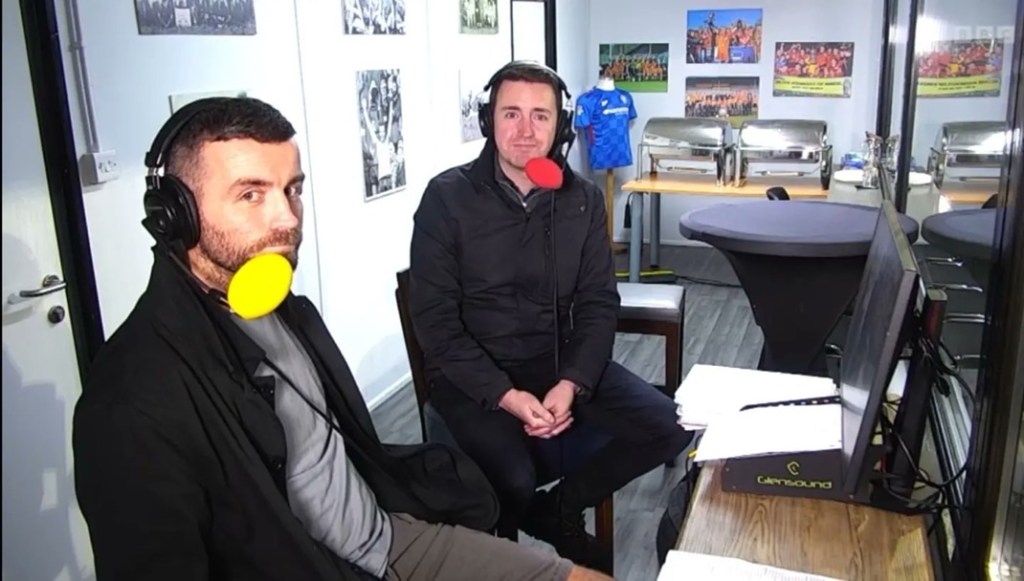
Final question, Colin, do you see yourself stepping into managerial role in the future?
“Right now, I love working with Paddy. I’m more than happy doing what I’m doing as I am learning so much from someone who’s been at a high level for a long time. It would be difficult to jump into a manager’s role without that kind of experience.
“Would I ever consider being a number one? Absolutely, it’s something I’d love to do. But at the moment, I’m focused on Glenavon, working with Paddy, and doing everything I can to help the club look up the table instead of over their shoulder. That’s the goal – push into cup finals, challenge for Europe, and keep improving.”
Featured image: Glenavon Football Club

